When Spare Parts Become a Food Safety Question: MOCA in Bottling Operations
In many bottling plants, MOCA documentation becomes relevant only when auditors ask for it.
At that moment, the question is simple:
Do we have confirmation that this component is suitable for food contact?
In practice, this question most often concerns spare parts.
Seals, pump elements, guides and other small components are replaced during maintenance. Once installed, they become part of the product contact environment.
What MOCA Means in Bottling Operations
MOCA refers to materials and components that come into contact with the product.
Any such component must not:
- release harmful substances
- change product composition
- affect taste, smell or quality
In bottling lines, this includes more elements than it may initially seem:
- seals and gaskets in filling valves
- pump rotors and stators
- pipelines and fittings
- conveyor guides
- components inside packaging machines
- valves and connection elements
Many of these parts are small and frequently replaced.
This is where the issue usually starts.
Why Spare Parts Become a Question
Production lines are rarely uniform.
Most plants operate with equipment from different OEMs installed over time. Spare parts are sourced from multiple suppliers — both original and compatible.
From a technical perspective, this is normal.
During audits, another question appears:
What exactly is this part made of and is it documented?
Very often, the answer is not immediately available.
Where the Problem Appears
Spare parts are typically treated as maintenance items.
However, once installed, they are part of the product contact zone.
This creates a gap:
- installed component → part of production
- documentation → not always available
This gap becomes visible during audits or internal reviews.
Why Documentation Changes the Situation
When components are supplied with:
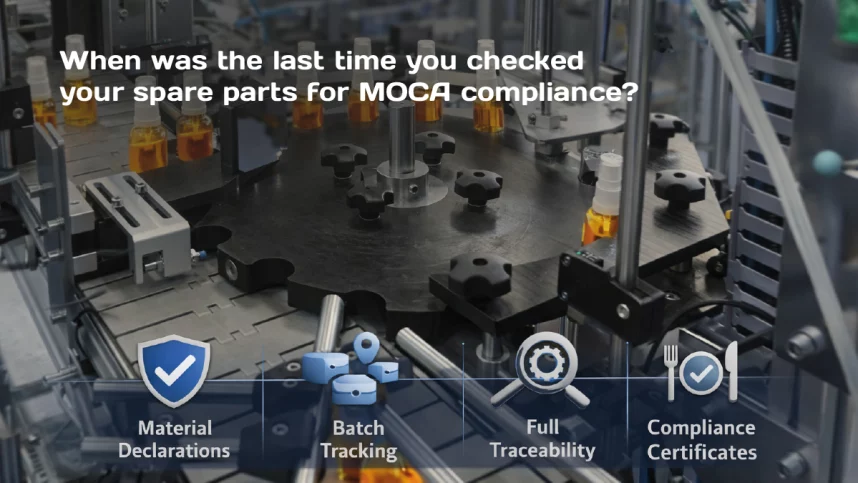
- material declarations
- batch identification
several routine processes become simpler:
- auditors can verify materials without additional investigation
- procurement decisions become more transparent
- compatible parts can be evaluated more confidently
- traceability shows origin and supply timing
This is not about compliance as a formality.
It is about maintaining clarity in the production environment.
Traceability as a Practical Requirement
If a product-related issue appears, the plant needs to understand:
- which components were installed
- from which batch
- from which supplier
Without this information, investigations usually expand.
With traceability, it is possible to focus on a specific component and a specific supply batch.
الخاتمة
Spare parts are no longer only a maintenance topic.
They are part of the production environment.
This means:
- documentation must be available
- materials must be identifiable
- supply must be traceable
These aspects are rarely visible in daily operations.
They become critical when questions arise.
MOCA refers to materials and components that come into contact with the product and must comply with food safety requirements.
Yes. Any component that contacts the product must have material confirmation, regardless of its size or role.
Because they are frequently replaced and may not always be documented or traceable.
Investigations may extend across large production periods instead of focusing on a specific component batch.